
Shipping Custom Solid Surface Products: A Packing and Receiving Checklist
Export packing should be planned around the finished product and the receiving site. This checklist helps buyers clarify responsibilities before dispatch.
Plan the receiving end before dispatch
A finished vanity top may fit a cabinet drawing yet still be difficult to receive at a warehouse or project site. The packed dimensions, unloading arrangements and identification of separate components all need attention before the shipment leaves the factory.
For bathroom brands, importers and project buyers, a clear packing and receiving brief helps connect fabrication with the next stage of the order. The questions below are a planning checklist; the actual packing and handling method must be agreed for the specific products.
Define exactly what is being shipped
List each finished item and any loose components. A multi-basin vanity, a long countertop and a collection of small CNC parts have different shapes and support requirements. Identify projecting edges, openings and separate backsplashes on the approved drawing so the packing proposal can account for them.
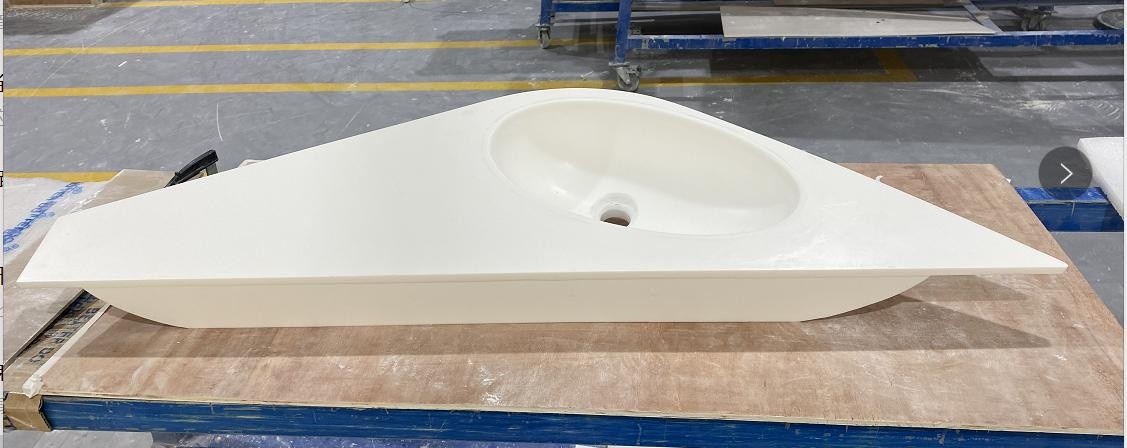
The catalogue photograph above illustrates an asymmetric basin top. It is included to show why product geometry matters, rather than as evidence of a particular packing system. For product options, explore Basins & Vanity Tops.
Request packed dimensions, not just product dimensions
Ask for the proposed number of packages, external package dimensions, gross weights and the relationship between each package and the packing list. Confirm whether these figures are preliminary estimates or final dispatch information.
Freight planning based only on the finished countertop size can miss the space needed for protective materials and external packing. Share the available receiving space and any restrictions early enough to discuss alternatives.
Agree unloading and handling responsibilities
Confirm who arranges unloading, what equipment will be available and where the shipment will be placed. A delivery to a distribution warehouse is different from delivery to a hotel project with restricted access.
Ask the supplier and freight provider for the applicable handling information. Do not infer lifting points or safe lifting methods from a photograph. The receiving team should review package weights and dimensions before delivery and arrange suitable people and equipment.
Record the packing scope in the order
Ask what the quoted packing includes, how the finished surfaces and vulnerable areas will be protected, and whether pieces travel assembled or separately. Any later site assembly should be identified in the agreed scope, with responsibilities clearly assigned.
If wooden packing is proposed, ask the supplier and freight forwarder to confirm the requirements applicable to the destination. Do not assume that one packing arrangement meets every country’s import rules. KSTONE’s Quality & Production page outlines the wider production and export preparation process.
Match labels to the buyer’s installation sequence
For repeated products, use item references that can be traced back to the approved drawings and purchase order. If units differ by room, floor or cabinet type, agree how those differences will appear on labels and the packing list.
Identify loose components and accessories separately. State whether fittings, installation materials or other accessories are included or excluded. A familiar product description is not enough to confirm the contents of a shipment.
Agree the dispatch records you need
Before shipment, discuss whether your team needs finished-product photographs, packing photographs, a package list or a first-order packing review. Confirm these requirements in advance instead of assuming that all records are automatically included.
Keep the approved drawing revision, order reference and dispatch documents together. This gives both teams a common reference if a question arises at receiving.
Use a structured receiving check
- Compare the delivered package count and references with the transport documents.
- Record the external condition before opening, including any visible damage.
- Photograph labels and relevant packaging conditions so the items can be identified.
- Follow the agreed unpacking and handling instructions.
- Check product identity and visible condition against the packing list.
- Retain relevant packing materials and notify the responsible parties promptly if a problem is found.
Follow the notification process and deadlines in the sales, transport and insurance arrangements. A general checklist does not replace those agreed terms.
Plan storage before the installation date
If products will wait before installation, request the applicable storage and support instructions. Tell the supplier about the expected storage period and conditions. Avoid improvising supports, stacking arrangements or temporary placement for shaped products.
For an order still at the design stage, our custom fabrication team can discuss the relationship between the proposed product breakdown, fabrication scope and delivery requirements.
Common buyer questions
Does export packing guarantee that nothing can be damaged?
No packing description establishes a damage-free guarantee. Agree the packing proposal, handling requirements and responsibilities, and follow a documented inspection process at receipt.
What should I send to obtain a useful packing proposal?
Send the product drawing, quantity, destination, receiving constraints and any required labelling scheme. Include the preferred delivery arrangement and ask which details remain to be confirmed.
Discuss your production and shipping brief
Send Your Drawings with the delivery destination and order quantity, or Request a Quote. If material selection is still open, review Materials & Colours and Request Material Samples before approving production.