Integrated, Undermount or Vessel Basin? A Vanity Buyer’s Guide
Compare the basin-to-deck detail, cabinet clearance and installation scope before specifying a bathroom vanity.
Choosing a basin for a bathroom vanity is also a decision about the countertop, cabinet, tap and installation sequence. For a bathroom brand or a project buyer, the right choice must work as a repeatable product specification—not just look attractive in a photograph.
Start by separating mounting style from manufacturing method. “Integrated”, “undermount” and “vessel” describe how the basin relates to the vanity top. They do not, by themselves, tell you whether the basin was made from fabricated sheet, thermoformed material or a moulding process.
What is an integrated solid surface basin?
An integrated arrangement aims for a continuous transition between the vanity deck and bowl. With compatible solid surface components, a bonded joint can be finished to make the transition inconspicuous. The assembly can still contain bonded parts: integrated does not automatically mean cast as one piece.
For procurement, request the proposed joint detail, basin geometry and colour combination. Review a physical sample when the transition is important to the design. Avoid a specification that promises an invisible joint in every colour and lighting condition.
This option is worth evaluating when your product brief calls for a coordinated top-and-basin assembly. Check the underside envelope carefully: a clean upper surface does not show you the space needed for the bowl, fixing details, waste and plumbing.
What is an undermount basin?
An undermount basin sits beneath an opening in the countertop. A separate ceramic or other basin typically retains a distinct interface with the deck. The cutout, exposed edge, seal and support arrangement need to follow the selected basin and countertop requirements.
The terminology can overlap. A solid surface bowl mounted underneath a compatible solid surface deck may be bonded and finished as an integrated assembly. Therefore, “integrated versus undermount” is not always a simple either-or comparison. Ask whether the supplier means a finished solid surface joint or a separate bowl sealed to the underside.
For original Corian® products, the manufacturer provides sink and lavatory fabrication guidance covering different installation methods. Use the instructions applicable to the actual material and basin model.
What is a vessel or countertop basin?
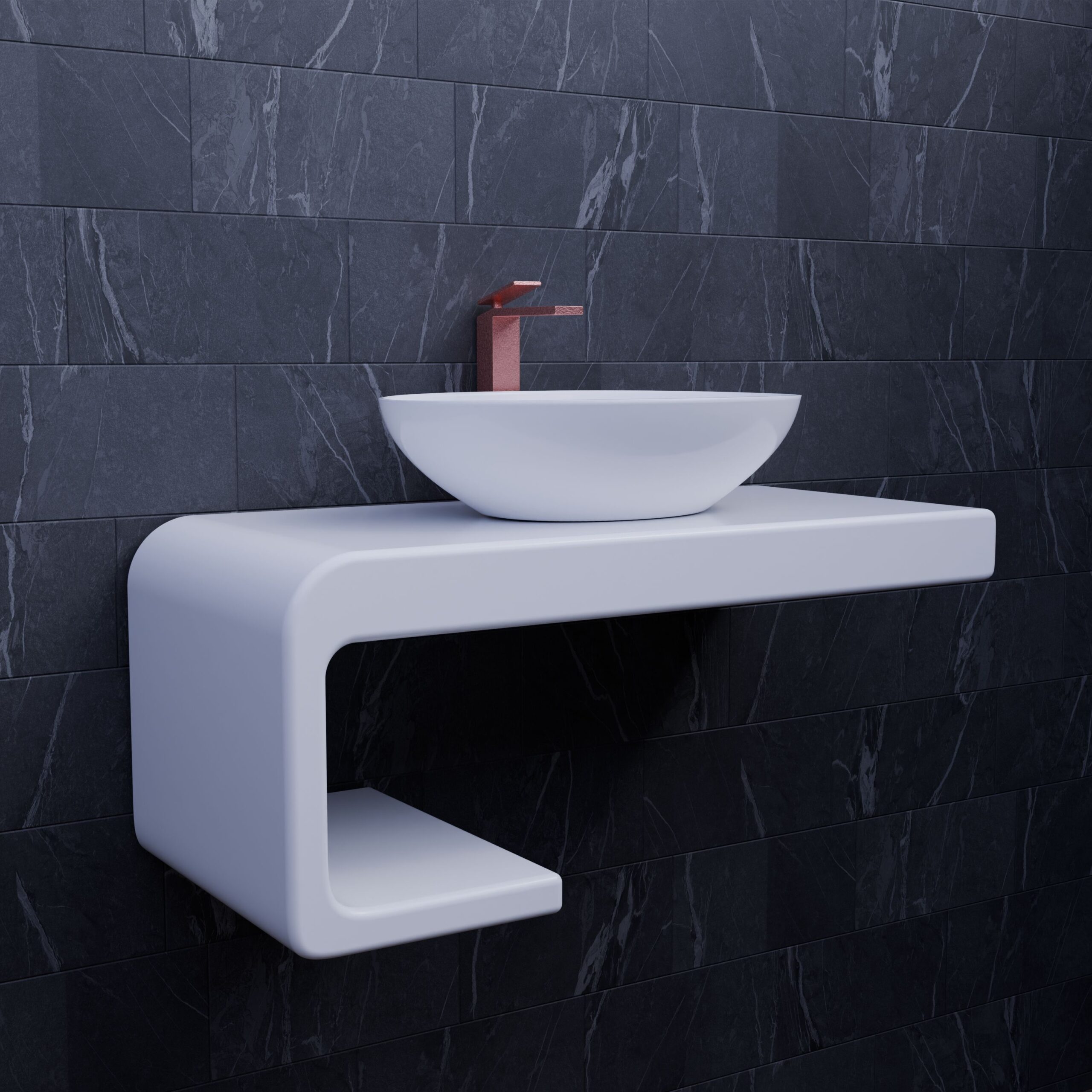
A vessel basin stands above the vanity deck rather than being concealed below it. Some models sit entirely on top; others are partly recessed. State the intended mounting arrangement in the drawing, together with the basin base and fixing information.
Because the bowl adds height above the deck, confirm the finished rim height as part of the complete cabinet design. Also check tap reach, tap height, the position of the water stream and access around the bowl for cleaning. A tap that works with one basin may be a poor match for another.
Compare the complete assembly, not just the basin price
Appearance and joints
For an integrated look, approve the deck-to-bowl transition. For a separate undermount, approve the cutout edge and reveal. For a vessel basin, approve the visible base junction, alignment and relationship with the tap. Request drawings of the actual proposed detail instead of treating a reference photograph as an approved specification.
Cabinet and storage space
Review a section showing the basin, drawer box, waste fitting and trap. A basin position that looks balanced in plan can conflict with a drawer or cabinet partition below. Check the available internal opening as well as the cabinet’s external width.
Installation and responsibility
State who supplies the bowl, cuts the top, bonds or seals the components, provides supports and installs the finished assembly. If different suppliers are involved, agree which drawing controls the interface and who approves the fit.
Maintenance and replacement
Discuss how the actual assembly will be serviced. A separate bowl may offer a different replacement route from a bonded and finished solid surface assembly, but replacement still depends on access, fixings and the cabinet construction. Do not assume either option can be changed without disturbing surrounding parts.
Six checks before ordering basins and vanity tops in quantity
- Identify the exact basin. Provide a model drawing or a dimensioned custom design. Confirm internal and external dimensions, depth and mounting method.
- Coordinate the deck. Mark basin centres, cutouts, tap holes, wall junctions and exposed edges. Distinguish actual deck thickness from the visible fascia depth.
- Confirm the waste and overflow. Select compatible fittings and establish whether an overflow is present. Share the fitting drawings before approving production.
- Check the cabinet section. Include drawer movement, internal partitions, supports and service access.
- Approve material and finish. Identify the original brand and colour, or the separate KSTONE option. Similar colours require sample confirmation and are not an identical branded substitute.
- Agree the supply boundary. List included components, assembly work, packaging requirements and the destination. Confirm what the local installer must provide.
A first sample should answer practical questions
A colour sample helps you review appearance. A first finished sample or prototype can also help verify the basin transition, waste fit, tap relationship and cabinet interface. For a new vanity range, define the checks before making the sample so it answers the decisions that matter.
Record any changes on a revised drawing. Once the approved design is ready for repeat production, use that revision, material reference and finish sample as the shared basis for the order.
Frequently asked questions
Does integrated mean a one-piece cast basin?
No. An integrated appearance may be achieved by bonding and finishing compatible components. Confirm the manufacturing method separately.
Can I use a basin from another supplier?
Ask for an interface review before ordering or cutting the top. The basin drawing, mounting template, fixing requirements and waste details must be available.
Which option is best for a hotel or bathroom brand?
There is no universal answer. Compare the complete design, approved appearance, installation responsibilities, maintenance access and total supplied scope. A representative sample is more useful than a decision based on the basin price alone.
Plan your basin and vanity top with KSTONE
KSTONE supplies standard and custom basins and vanity tops, with sheet production and fabrication capabilities that can be coordinated around your project. Tell us the mounting style, intended material, quantity and delivery country. Send a plan and section, plus the tap and waste information if already selected.
Send Your Drawings · Request a Quote · Request Material Samples
Featured design illustration: Pușcaș Adryan / Pexels, used under the Pexels License. Shows a vessel-basin arrangement for design reference; not a KSTONE product or project. Material is not verified.